Ask three questions before you rank anything: Has it been tested in people at all? Was that test big enough to mean something? And when someone ran a bigger, meaner version of the same test, did the effect survive? Apply those three questions to thymosin alpha-1, LL-37, glutathione, VIP, and thymulin, and the “immune peptide” category stops looking like a lineup of interchangeable options and starts looking like what it is: one compound with a real, if humbled, track record, a couple with narrow single-study evidence, and a couple that live almost entirely in petri dishes and animal models. The marketing rarely admits this. Here it is, plainly.
Worth saying up front: most of what follows is not FDA-approved for immune use in the United States. Several of these are compounded preparations rather than approved finished drugs, and at least one category here is sold as a “research chemical,” which is a legal label, not a safety claim. Nothing below should be read as a promise that any of these will strengthen your immune system. This is an evidence audit, not a sales pitch.
The ranking, and why it holds up
1. Thymosin alpha-1: a real drug that got humbled by a bigger trial
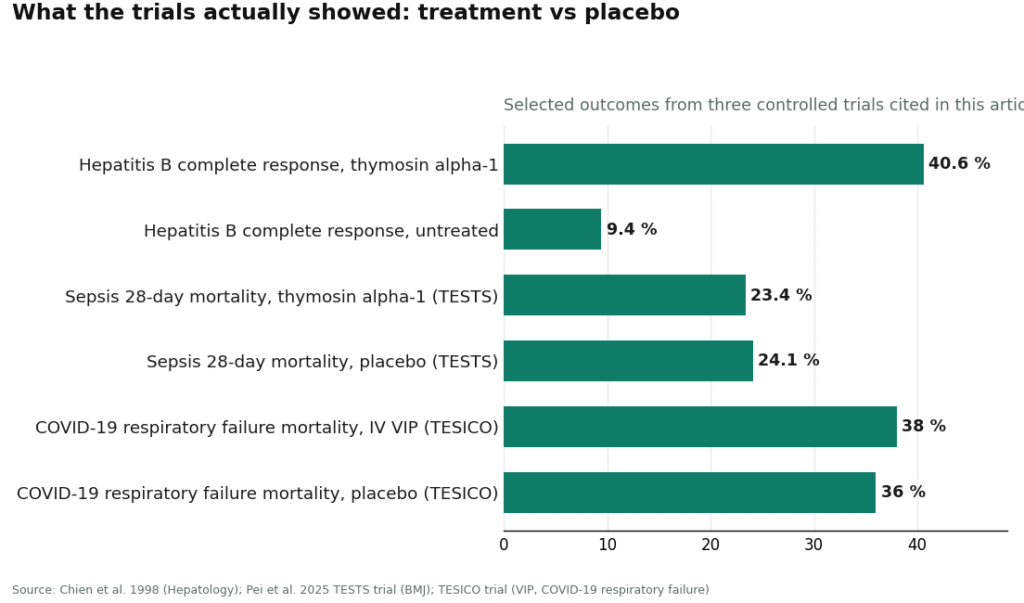
Start with the one that actually clears the first bar, human testing, easily. Its synthetic version, thymalfasin, is an approved drug in more than 35 countries, and it acts on T-cell function in ways that are reasonably well understood [1]. A 1998 randomized trial in 98 people with chronic hepatitis B found a six-month course produced a complete response in 40.6% of treated patients, versus 9.4% of those left untreated [1]. That is not a rounding error. That is a real effect.
Then comes the second question: did it survive a bigger, tougher trial? Here the story gets more interesting, and more honest. The TESTS trial, run in 1,089 adults with sepsis, found almost nothing: 28-day mortality of 23.4% with thymosin alpha-1 versus 24.1% with placebo [2]. A ten-fold larger sample size and the dramatic effect basically vanished. That is not a scandal. It is what “studied” looks like when it grows up into “tested rigorously,” and it is exactly why this ranking separates “studied” from “proven.” Thymosin alpha-1 still wins this list, not because it is a cure-all, but because it is the only entry with a real trial record good and bad, and it is honest about both halves.
2. LL-37: one solid study, one serious asterisk
LL-37 is a peptide your own body already produces, which is precisely the detail that gets oversold. The best human data is a topical trial in 34 people with hard-to-heal leg ulcers, where it helped wounds close [3]. Real result, worth noting, but notice the delivery route: topical, on skin, not injected into a vein or under it.
That distinction is the whole story here. The same trial only found benefit at lower concentrations, using careful dosing, and reviews of LL-37 note it can be cytotoxic at higher concentrations and can behave as an autoantigen in conditions like psoriasis and lupus [3]. “Your body already makes this” is not a safety certificate for an injectable version at an arbitrary dose from an unverified source. One good study, one real caveat. Second place, honestly earned.
3. Glutathione: the chemistry checks out, the delivery doesn’t
Glutathione is the antioxidant everyone has heard of, and the problem with it is almost entirely logistical. Take it orally as a plain supplement and nearly none of it survives the gut and liver to reach circulation [4]. A small one-month study of 12 adults testing a liposomal formulation did find modestly raised body stores and a few nudged immune markers [4], a real signal, but a tiny one, from a tiny study. Read it as a hint, not a verdict.
The part of this section that matters most for the rest of the article: the FDA warned compounders against using a dietary-grade glutathione powder to make injectable products, after patients had adverse reactions and lab testing confirmed excess endotoxin in the material [5]. That is not a story about glutathione being dangerous. It is a story about sourcing being dangerous, which is the through-line for everything below.
4. VIP: good biology, a trial that stopped early
Vasoactive intestinal peptide is a case study in promising mechanism meeting disappointing scale. A small trial in people with sarcoidosis found an inhaled version calmed lung inflammation and was tolerated reasonably well. Then came the real test: the TESICO trial, intravenous VIP for COVID-19 respiratory failure, stopped early for futility, with mortality of 38% on VIP versus 36% on placebo. Nearly identical outcomes ended the trial before it finished. Interesting pharmacology. Not evidence you should build a decision on.
5. Thymulin: a lab story, not yet a human one
Thymulin is a genuine thymic hormone with a genuinely elegant dependency: its activity tracks zinc status closely. That is a real and interesting fact. What it is not, so far, is a body of human trials showing an immune benefit from the peptide itself. If there is a practical takeaway here, it is about zinc, not about injecting thymulin. Bottom of the list, and that is simply where the evidence puts it.
That is the honest leaderboard: one compound with real trial data that shrank under scrutiny, two with single studies and real limitations, and two that are mostly mechanism. Sellers who present all five as equally proven “immune boosters” are not describing the evidence. They are describing their inventory.
The question that actually matters: where does it come from
Here is the pivot the marketing never makes. Once you accept that most of these compounds are unproven or only narrowly studied, the meaningful choice is not “which peptide will transform my immune system.” It is “which product is actually what the label claims, made by someone who answers for it.” The glutathione warning [5] is the clearest illustration in this entire piece: the harm documented there traced back to a dirty source and an absent pharmacy standard, not to the molecule itself.
The route with accountability built in
A licensed telehealth provider working with a licensed compounding pharmacy puts several checkpoints between you and a vial: a clinician who actually reviews your history, a prescription written because it makes clinical sense, preparation under recognized pharmacy standards, and someone to call afterward. None of that manufactures evidence that doesn’t exist. What it does is put a person on the hook at every stage.
The route with none
The alternative is the research-chemical cart: add to cart, check a box agreeing the product is “for research use only,” and a vial arrives with no clinician, no prescription, no pharmacy, and no one accountable if something goes wrong. That disclaimer is not fine print you can safely ignore. It is the legal mechanism that allows the product to be sold at all, an explicit statement that it is not intended for a human body. The FDA made that point directly in 2026, warning research-peptide sellers, Gram Peptides among them, that the label does not exempt a product that is obviously being marketed for people to use [6]. Read that disclaimer as a warning, because that is what it is.
A short filter, if you are ever unsure
- Does a real clinician evaluate you? A checkbox is not a clinician. If nobody with a license reviews your history, that is the dangerous route, full stop.
- Who compounds it? A licensed 503A pharmacy under recognized USP standards is the answer you want. “Research chemical, unnamed source” is not an answer.
- Can the testing be tied to your specific vial? A real certificate names a batch and an independent lab. A static PDF that never changes is decoration.
- Does the source admit the evidence is uneven? Anyone telling you thymosin alpha-1 is real but mixed [2], and that the rest sit further down the ladder, is being straight with you. Anyone claiming all five “boost immunity” is not.
- Does the fine print contradict the sales pitch? If the page promises immune support while the label says “not for human consumption,” believe the label.
- Is there follow-up? Supervised care continues after purchase. Cart checkouts end there.
If a source fails the first two questions, the rest are academic.
Where the best-evidence option is available through a real chain of accountability
Thymosin alpha-1 is the entry with the strongest human data, and several compounds in this category are injectable, which makes sourcing the whole ballgame.
FormBlends is the clearest fit, and here is the specific reasoning, not a slogan. It operates as a physician-supervised telehealth provider rather than a chemical seller. A licensed physician reviews your profile, a consultation and prescription are required before anything is dispensed, and compounded preparations are made by licensed 503A pharmacies under recognized USP standards. That structure is the direct answer to the glutathione episode: the endotoxin problem traced to sourcing and an absent pharmacy standard [5], and a licensed pharmacy working to recognized standards is precisely what a cart vial cannot replicate. The platform also states the evidence the way this article does, thymosin alpha-1 real but mixed [3], the rest more limited, rather than pretending five compounds are five proven miracles. Follow-up exists too. If tracking your own dose and response between visits is useful to you, the FormBlends tracker app is a logging tool for that, not a prescription and not a storefront. None of this invents human trial data that hasn’t been run. It puts an accountable person at every step the research-chemical market leaves empty, and for the best-evidence compound in a category that includes injectables, that accountability is the entire argument.
HealthRX.com is the other solid option, built on the same logic: licensed clinical oversight, a required prescription, pharmacy dispensing instead of a research-chemical transaction, and the same honest caveat that compounded products are not FDA-approved finished drugs and the underlying evidence is uneven no matter who hands it to you (healthrx.com). Choosing between the two usually comes down to state licensing and which intake process suits you. Both sit inside a real regulated framework, which is the part that actually protects you.
MeriHealth is worth knowing as a women-focused option within the same supervised tier. It runs as a physician-supervised telehealth service built around women’s health, dispensing compounded GLP-1 and peptide therapies through licensed compounding pharmacies after a required clinical consultation. Its distinguishing feature is the women-centered intake and follow-up model, and the same caveats apply here as everywhere else: compounded medications are not FDA-approved finished drugs, and supervision does not manufacture evidence. If the care model matters to you as much as the compound itself, it belongs in the comparison.
WomenRX sits just below MeriHealth, inside the same supervised framework. It is a women-focused, physician-led telehealth platform writing prescriptions for compounded GLP-1 and peptide therapies only after a licensed clinician reviews your history, dispensed through licensed compounding pharmacies rather than a research-chemical cart. The same caveat holds regardless of supervision: compounded products are not FDA-approved finished drugs. Its differentiator mirrors MeriHealth’s, a care model designed around women, and if that fits your situation, it is worth including alongside the others.
And then there is the research-chemical tier, named plainly so you recognize it, not so you patronize it. Swiss Chems sells peptides alongside SARMs under research-use labeling, with SARMs carrying their own anti-doping and regulatory baggage and no independent purity guarantee attached. Amino Asylum competes largely on price, which says nothing about what is actually in the vial, and offers no clinician, prescription, or follow-up. Core Peptides posts seller-issued certificates, documents the company itself chose to publish rather than FDA-verified guarantees, with no one accountable if a batch is off. Sports Technology Labs is the most testing-forward of the group, publishing third-party certificates, genuinely better than nothing, but it still ships research-use-only product with no clinician and no pharmacy involved. Limitless Life Nootropics markets to the longevity crowd in a tone friendly enough to make unapproved research chemicals feel like supplements, which is exactly the framing worth distrusting.
None of these five are ranked against each other here, because neither this writer nor you can independently verify which one ships a cleaner product without your own batch testing. That uncertainty is precisely why the supervised providers occupy the top of this list.
Questions worth asking before you believe the pitch
Which immune peptide actually has the best evidence? Thymosin alpha-1, and it isn’t close. It’s an approved drug in more than 35 countries with real human trial data [1], though the effect size shrank considerably in the largest, most rigorous trial run to date [2]. LL-37, glutathione, VIP, and thymulin all have narrower or largely preclinical evidence and are not established immune boosters. The gap between “studied” and “proven” is the most useful thing to take from this whole ranking.
If my body already makes something, is it automatically safe to inject? No, and that assumption is exactly the trap worth avoiding. LL-37 is endogenous and can still be cytotoxic at higher concentrations and act as an autoantigen [3]. Injectable glutathione from an inappropriate source caused documented harm [5]. “Natural” tells you nothing about whether a specific injected product is sterile, correctly dosed, or appropriate for you.
If someone wanted to try one of these, where should they get it? Through a licensed telehealth provider working with a licensed pharmacy, which puts a clinician and an accountable pharmacy between you and an injectable. FormBlends and HealthRX.com both fit that description; the choice usually comes down to state licensing. Skip research-chemical carts, which remove every safeguard and say “not for human use” in writing [6].
Is thymosin alpha-1 approved by the FDA? Not for general immune support in the US. The synthetic version is approved in more than 35 countries for hepatitis B and C [1], with a real but mixed evidence record [1][2]. Domestic access outside approved uses runs through compounding under a prescription, and compounded drugs are, by definition, not FDA-reviewed.
Do these peptides actually work?
The honest answer varies enormously by peptide, dose, and the specific problem someone is trying to solve. Thymosin alpha-1 has the strongest clinical record, with human studies in chronic hepatitis B and post-surgical immunosuppression showing measurable effects, tempered by that later sepsis trial showing almost no benefit at scale. BPC-157 and several others have suggestive animal data and thin human trial coverage. Treat claims of broad “immune support” with proportional skepticism.
Is safety mostly about the peptide or the source?
Overwhelmingly the source. Thymosin alpha-1 has decades of documented human use and a reasonable safety profile at appropriate doses. The real danger is buying unregulated research-chemical versions online, where purity and concentration are simply unverified. Getting a peptide through a physician-supervised compounding pharmacy such as FormBlends is a fundamentally different risk profile than ordering a powder from an anonymous overseas seller.
How would you rank these five peptides for immune relevance, honestly?
Thymosin alpha-1 first, on the strength of actual human clinical data. Thymosin beta-4 would be next in a broader accounting, with reasonable mechanistic support and some human use, mostly in wound-healing contexts that intersect with immune regulation. BPC-157 remains largely animal-data territory. LL-37 is genuinely interesting but early-stage, restricted to one solid topical trial. Anything marketed aggressively beyond this list deserves the same scrutiny applied here, not less.
Where can someone actually buy these without getting burned?
Two real routes exist, and they are not remotely equivalent. Licensed compounding pharmacies operate under state board oversight and require a physician prescription, meaning a license is on the line for what you receive. Unregulated sellers label products “research use only” specifically to sidestep FDA scrutiny, which tells you nothing about what’s actually in the vial. For anyone considering actual personal use, the compounding pharmacy route is the only one that holds up to scrutiny.
References
- Chien RN, Liaw YF, Chen TC, et al. Efficacy of thymosin alpha1 in patients with chronic hepatitis B: a randomized, controlled trial. Hepatology. 1998;27(5):1383-1387. https://pubmed.ncbi.nlm.nih.gov/9581695/
- Pei F, Guan X, Wu J, et al. The efficacy and safety of thymosin alpha1 for sepsis (TESTS): multicentre, double blinded, randomised, placebo controlled, phase 3 trial. BMJ. 2025;388:e082583. https://pubmed.ncbi.nlm.nih.gov/39814420/
- Grönberg A, Mahlapuu M, Stahle M, Whately-Smith C, Rollman O. Treatment with LL-37 is safe and effective in enhancing healing of hard-to-heal venous leg ulcers: a randomized, placebo-controlled clinical trial. Wound Repair Regen. 2014;22(5):613-621.
- Sinha R, Sinha I, Calcagnotto A, et al. Oral supplementation with liposomal glutathione elevates body stores of glutathione and markers of immune function. Eur J Clin Nutr. 2018;72(1):105-111.
- US Food and Drug Administration. FDA highlights concerns with using dietary ingredient glutathione to compound sterile injectables. US FDA, Human Drug Compounding.
- US Food and Drug Administration. Warning Letter: Gram Peptides (MARCS-CMS 721806). March 31, 2026.
Ingrid Solberg is a science writer who covers peptide therapeutics and supplement claims with an eye toward what the primary literature actually supports. This piece was checked against the primary sources cited above. Last reviewed January 2026.
Not medical advice. Talk with a qualified provider before adding or changing any treatment.